Monthly lump checks could save your pet's life.
Lately we have had more than the usual amount of appointments to examine lumps — and more than a few of them have been lumps of concern. So, it seems like a good time to encourage all of you to do a Monthly Lump Check on your pets. This does not need to be difficult or invasive. In fact, to your pet, this should just feel like a nice cuddle or massage. If you do it just after your pet has been outside, then you can check them for ticks at the same time. Win, win.
This is sometimes harder to do in cats because they have their "no, no spots" — you know, those areas that might get you bit if you touch them there. Give it a try, do your best but be safe. My cat Li'l Stinker has a lot of "no, no spots" so I try to sneak in a feel when he is sleeping. He wakes up a bit grumpy but I usually get away with it.
To do a lump check just run your hands over their face, head, ears, body and legs. Don't forget to look between the toes and down the tail. Even in the mouth and on the bum are good places for lumps to hide.
If you find a lump, take note of where it is, how big it is, is there fur covering it or is it naked, is it hard or soft, can you move it in the skin or is it attached to the body, and what colour it is.
While more than half of lumps found on dogs are fatty tumors and benign (not cancerous), it can be hard to tell. It is best to book an appointment with your veterinarian to have the lump examined. If your veterinarian is unsure of the lump's cause, a test called a Fine Needle Aspirate can be done. This is not a very invasive test — no worse than a vaccine needle for your cat or dog. Depending on the type of lump, your veterinarian may need to do further testing like biopsies or x-rays.
Lumps of concern are new lumps, lumps that are growing quickly, red, bald or ulcered. Even old lumps that feel or look different to you might warrant a follow-up with your veterinarian.
A very useful tool is a Lump Tracking Chart — a chart where we can record the location and size of your pet's lumps. You can do this at home too: draw the lump on the chart, write the date you found the lump and the size of the lump. Pictures are great too. To make it easier, we can share our Lump Tracking Chart with you — download the cat and dog versions below.
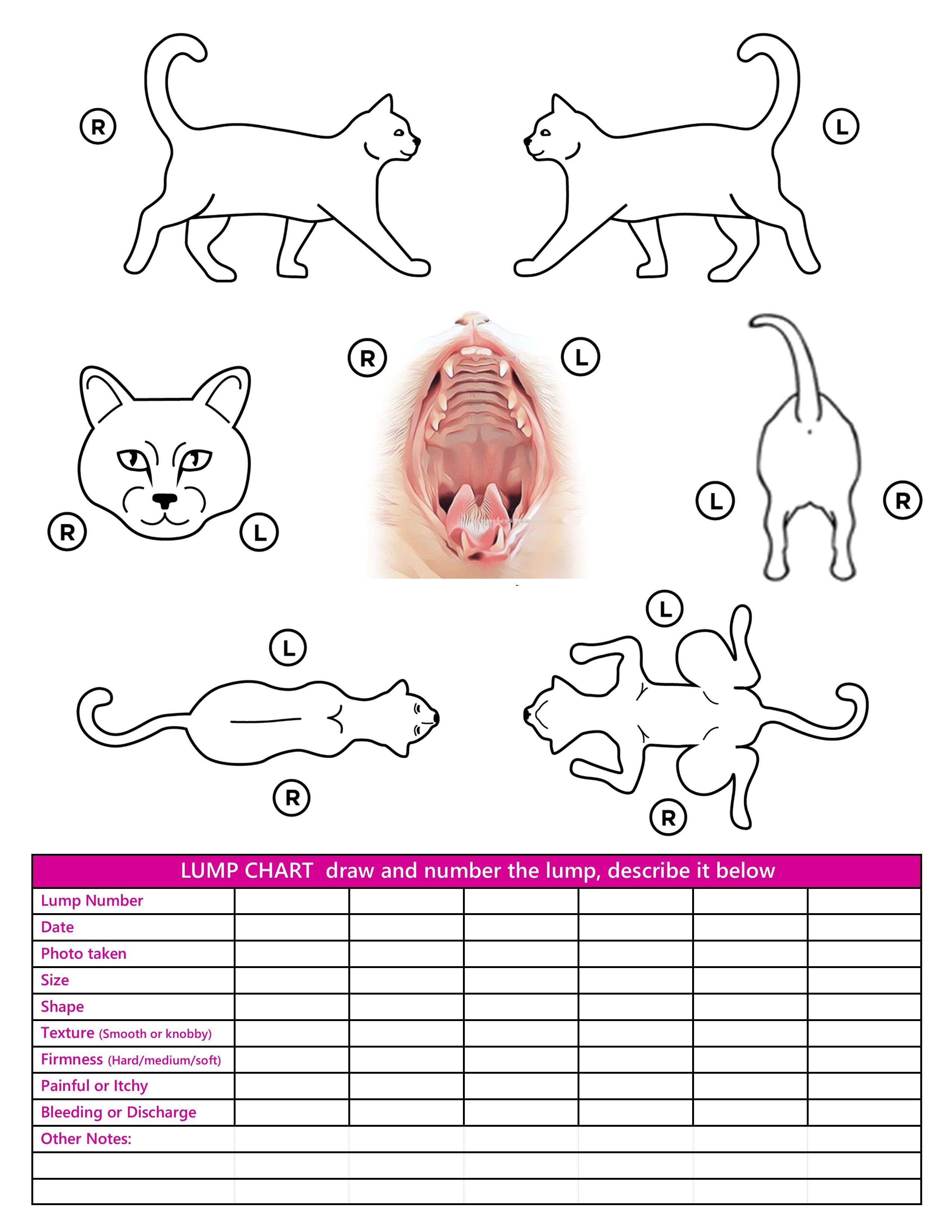
Lump Chart — Cats
A body map of all the places lumps hide, plus a tracking table for size, shape, texture and notes. Print one per pet.
View / Print Chart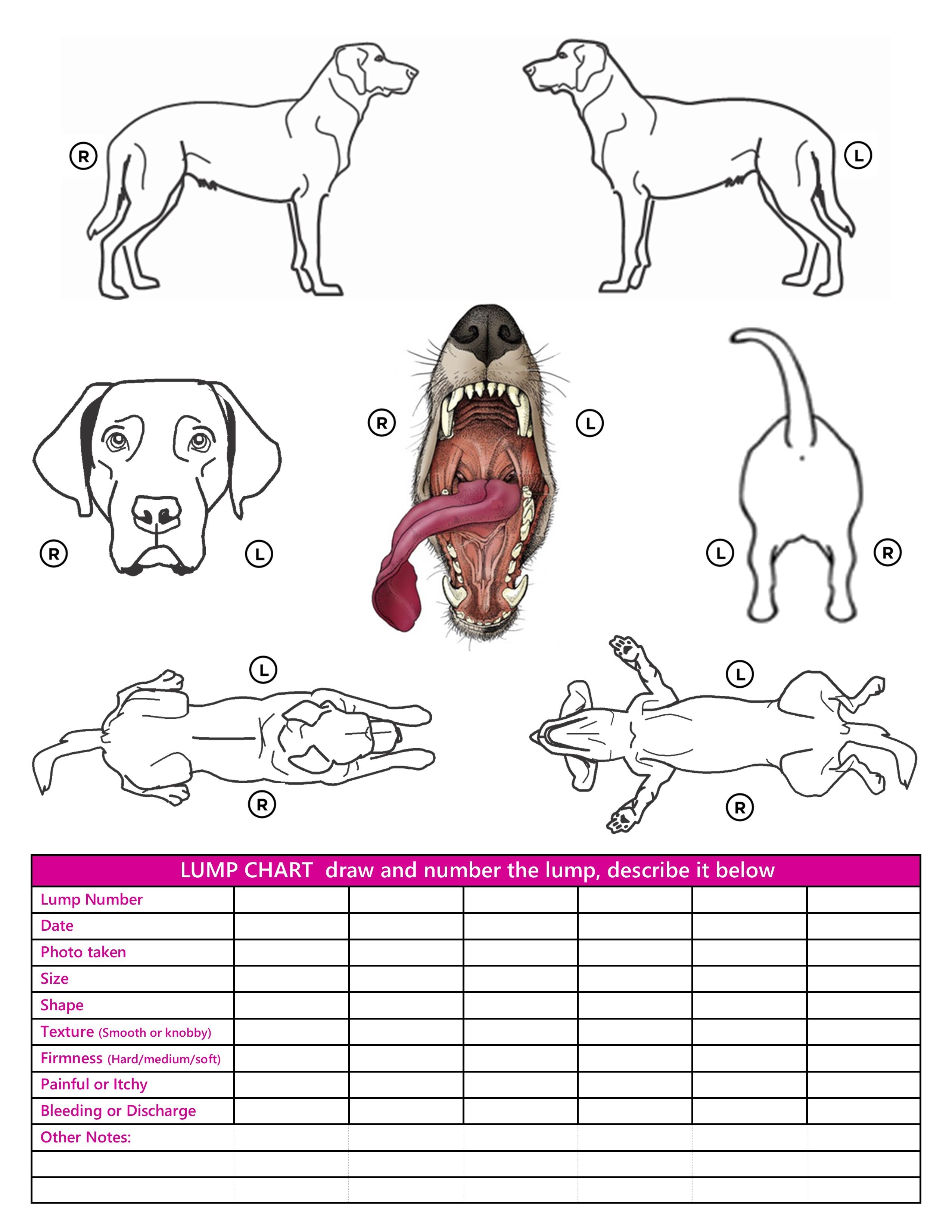
Lump Chart — Dogs
The same body map and tracking table, drawn for dogs. Bring it along to your next appointment — we love it.
View / Print Chart
Time with Tux — I just celebrated my 15th birthday!
My stealth feline ears can hear you all gasp with amazement and shock as to how young and hot I still look. It is true, I do look fabulous! I feel fabulous too. Except for the cancer scare last year, which by the way, I breezed though, I have been nothing but the picture of good health.
What's my advice to aging this well, you ask? Let your people take care of you. Let them take you to the doctor for wellness checks, quit being so picky about the special diets they offer you and let the humans check you out. Turn all the "no, no spots" to "yes, yes spots". If you just drop the cattitude, you'd have to admit, being massaged and touched everywhere actually feels pretty great. I let all the ladies here touch me all the time, and I like it!
How to check your pet for skin cancer at home.
- Slowly examine your pet from nose to tail and top to bottom to help find skin tumors.
- Always start in the same place.
- With your fingertips, feel around the muzzle, the eyes, then along the ears and the neck.
- If your pet allows you to do so safely, check for lumps and bumps in and around the mouth and muzzle.
- Stay consistent and work down each side. Have them stand up so that you can check the inside and outside of the legs.
- Check between their toes, paw pads, and don't forget the tail.
- Take note of the size and location of any lumps and bumps you find; your veterinarian will want to see them and will make recommendations based upon their findings. You can use the lump chart above to record your findings.
- REMEMBER: catching skin cancer early is always best.
Choose a consistent day of the week to check your pet. "Snuggle Sundays" can help make it easy to check your pet for skin cancer at home. Examining your pet is like giving them a massage, which can relax them and make them look forward to being checked.
Prefer a walkthrough? Watch the short "how to check your pet" video — it takes less than three minutes.
This checklist was produced by Virbac Corporation (©2022 Virbac Corporation, All rights reserved, 7/22 15022) and is reproduced with permission.
A winter reminder about ticks.
While heartworm transmission is over for this year, ticks are still a threat. Ticks are active any time the temperature is above 0°C, even during the winter months! To prevent tick bites and the spread of Lyme disease, Anaplasma and Ehrlichia, dogs and outdoor cats should be on tick prevention year round.
Ask us about the best prevention products for your pets.
Holiday hours.
What to do in an emergency over the holidays.
Unless otherwise specified here, Mountainview Animal Hospital will be open during its regular office hours. Animals in the hospital over the holidays will receive the same great care and attention as always. For those patients requiring emergency care over Christmas and New Years:
From all of us at Mountainview Animal Hospital, we wish all of you a Very Merry Christmas, a Joyous Holiday Season and a Happy New Year. 🎄