
You are invited to our Meet the Doctors Day.
Ever wonder what the clinic looks like "at the back"? Have you had the opportunity to meet all our doctors? Well, now's your chance.
Why should you come to our open house?
- Meet our doctors and staff on a more personal level, and take a tour of the hospital
- Learn more about our various services and equipment.
- Learn more about important topics in pet health care. We have a different topic in every room & we have made it fun!
Meet the Doctors Day
To show our appreciation to our wonderful community, we are having an Open House / Meet the Doctors day.
Everyone is welcome to attend: adults, kids, and of course your furry friends. Come have some fun with us!
This event has now taken place — watch future newsletters for the next open houseFor the kids: the Teddy Bear Clinic.

It's time for your friend's annual physical examination! Have your kids bring in their favourite stuffed animal for a check-up.
Our trained Teddy Bear Doctors will check Teddy's vital signs, give vaccines, apply bandages and check overall health.
Stuffies will receive a certificate of good health. And yes — there will be a warm cup of cocoa, some cookies, and prizes!

Time with Tux — that thing humans do after Christmas.
I have noticed every year, after Christmas, an interesting ritual. The humans walk in the door, stomp their feet, pat themselves and do an upper body shiver; it's a peculiar little dance. Not to be left out, the dogs also give a good, full body shake. Many of the dogs have matching outfits with their humans, bright coloured hats, puffy coats and clunky footwear. They decorate the floor with cold white stuff that melts into water, and tiny chunks of salt. They combine this with a kind of song, they all seem to know the lyrics to: "Oh my god, it's so cold outside" or various versions of "I hate the winter". While I find it strangely humorous, as an indoor cat whose environmental temperature does not change from 72 F, I don't get it!
Your pet should never be a meal for parasites.
Ticks. Little vampires with a dangerous bite.
TICKS are like little vampires — they bite to feed off the blood of their host. Their bite does not hurt, so the host is unaware that this ugly little creature is using them for dinner. As a result, a tick can remain attached & feeding for several days before it is engorged (full) & falls off into the environment. Look for ticks around the ears, neck, groin & armpits of your pets.
In large enough numbers, the tick can cause anemia. They also transmit a number of very devastating diseases, both to animals & people. In Canada, we are mainly concerned with Lyme Disease, Ehrlichiosis and Anaplasma. We can test for these diseases with the same blood test we use to look for heartworm disease.
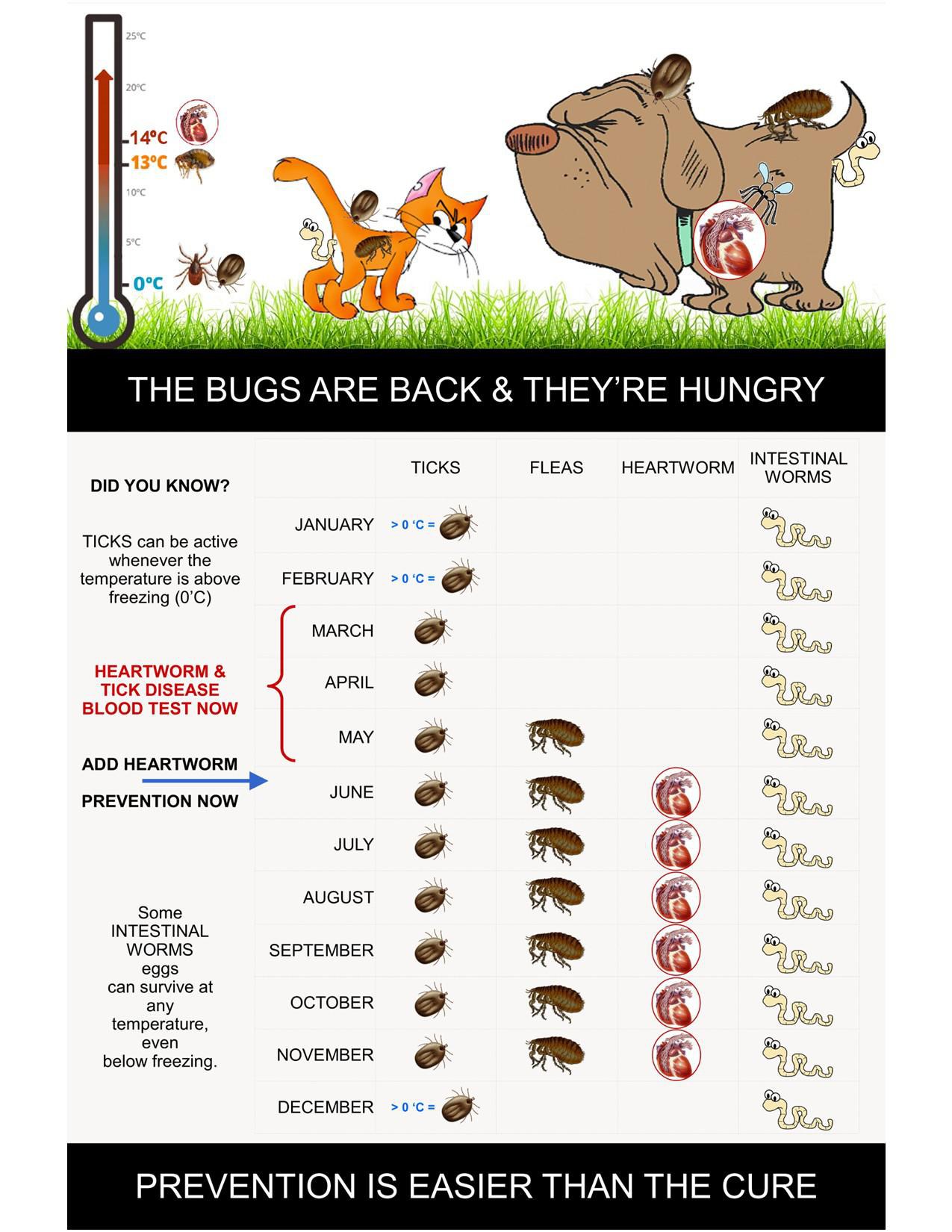
The ticks are found in tall grass and the leafy material under trees, just waiting to ambush innocent folks & their pets. Ticks are no longer just a concern in the summer — they are a risk even during those winter warm ups; the tick will be actively seeking hosts as soon as the temperature reaches 0°C.
There are a number of veterinary approved products available to prevent or kill ticks. They can be applied as a topical liquid or given as an oral chew. Warning: some of the medications available to our dogs can be toxic to cats, so it's best to consult your veterinarian.
We would be happy to talk about which product will work best to avoid a tick infestation on your pet.
For more info on ticks: ticktalkcanada.com — and read our Volume 42 (Spring 2020) newsletter.
Heartworm. A foot-long threat you can't see.
The HEARTWORM is a slender worm growing to almost a foot in length & lives in the blood vessels of the heart and lungs. It causes disease related to heart, lung & liver damage, & eventually causes death. Heartworm is spread from dog to dog by mosquitoes.
Treating heartworm disease is difficult, many harsh & expensive medications, & a lot of veterinary care is required. Beware, the battle to kill Heartworm can be deadly to the host dog as well.
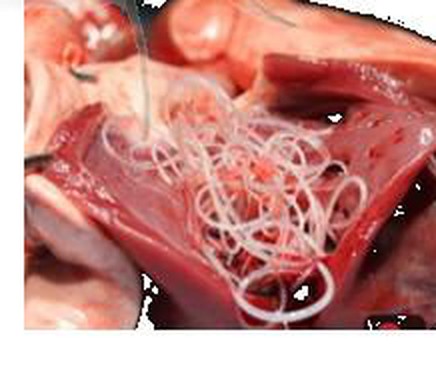
The best way to manage heartworm disease is prevention. Every year we screen dogs for heartworm disease by a simple blood test. This same blood test is also used to screen for tick diseases. Once we know the dog is negative for heartworm disease, we start them on monthly medication throughout the summer from June 1st to November.
For more information on heartworm disease: heartwormsociety.org
Fleas. Itchy, relentless, and living in your sofa.
The adult FLEA spends its entire life on the pet biting & feeding on their blood. A female flea can lay up to 50 eggs per day. These eggs fall off your pet & hatch; the resultant larva live in your carpet, beds, sofas & chairs.
Biting fleas cause severe itchiness, allergic dermatitis & enough blood loss to make your pet anemic. Fleas can also transmit intestinal tapeworms to your pet. This long worm lives in the stomach and intestines, robbing your pet of important nutrients.
Treating a flea problem involves two stages: eliminating the adult fleas on your pet, as well as the eggs & larva in your home. There are a large variety of products available.
Of course, an ounce of prevention is worth a pound of cure. There are a variety of products available that can prevent a flea infestation before it starts, some of which can be combined with the heartworm, tick & intestinal parasite prevention in cats & dogs.
For more information on fleas: mountainviewanimalhospital.ca/library
Intestinal parasites. The hidden hitchhikers.
INTESTINAL PARASITES like Roundworms, Hookworms, Whipworms, Tapeworms, Coccidia & Giardia can all live in your pet's stomach & intestines. They are picked up in your backyard, on walks & some even directly from your pet's mom before & after birth.
Unfortunately our pets cannot complain about the milder tummy upsets they may experience, so you may not be aware of the problem. More serious symptoms are vomiting, diarrhea, anemia, & malnutrition.
While transmission is most common in the summer months, freezing temperatures do not kill these parasitic eggs. Testing your pet's poop for the microscopic eggs regularly & giving medications to prevent infection is the best way to keep your pets healthy.
For more information on intestinal parasites, see the Companion Animal Parasite Council: capcvet.org
The bugs are back — know their season.
Does my dog need a Heartworm (4Dx) test?
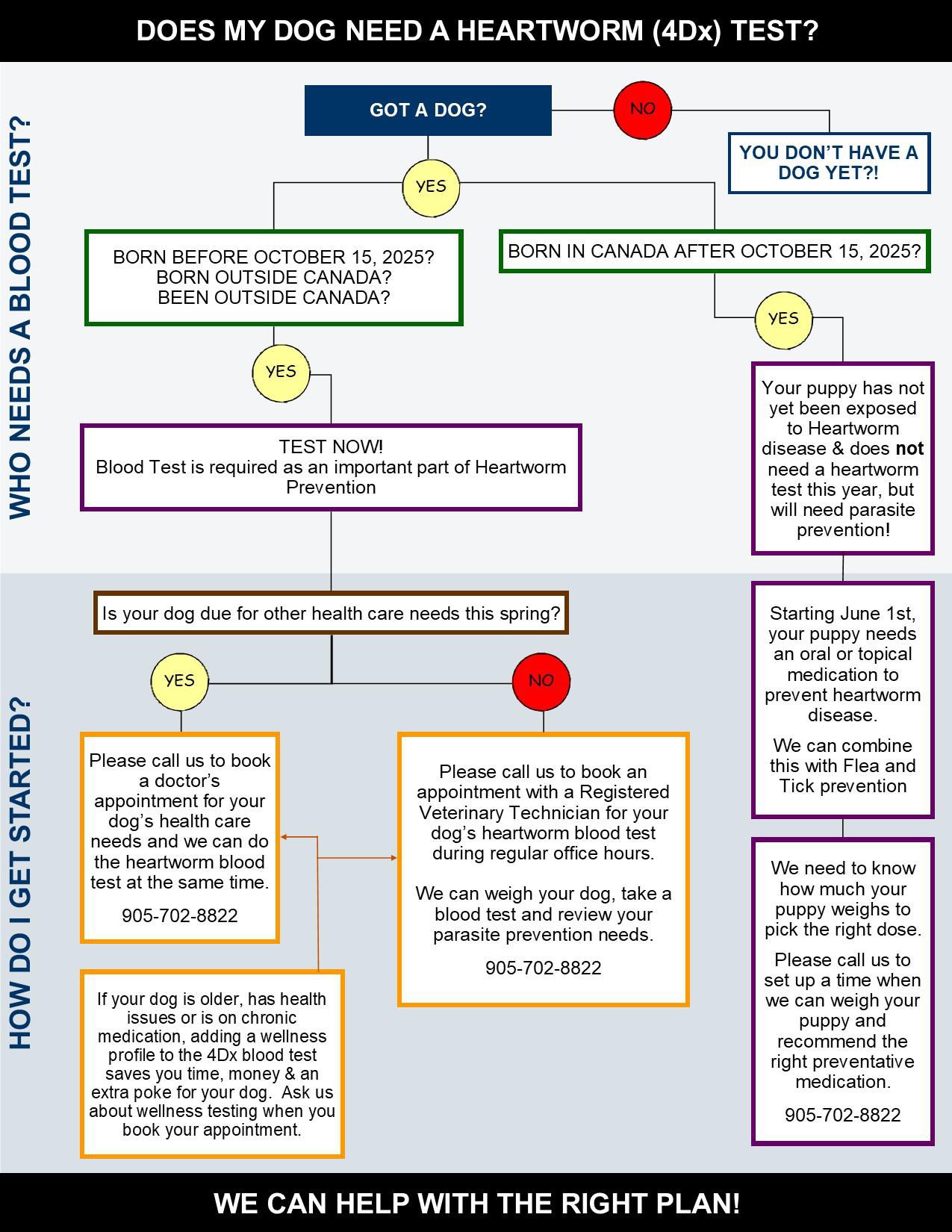
In short: dogs born before October 15, 2025, born outside Canada, or that have been outside Canada need a blood test as an important part of Heartworm Prevention. Puppies born in Canada after October 15, 2025 haven't yet been exposed to Heartworm disease & don't need a test this year — but they will need parasite prevention starting June 1st, an oral or topical medication we can combine with flea and tick prevention.
If your dog is due for other health care needs this spring, book a doctor's appointment and we can do the heartworm blood test at the same time. If your dog is older, has health issues or is on chronic medication, adding a wellness profile to the 4Dx blood test saves you time, money & an extra poke for your dog. Ask us about wellness testing when you book your appointment — we can help with the right plan!